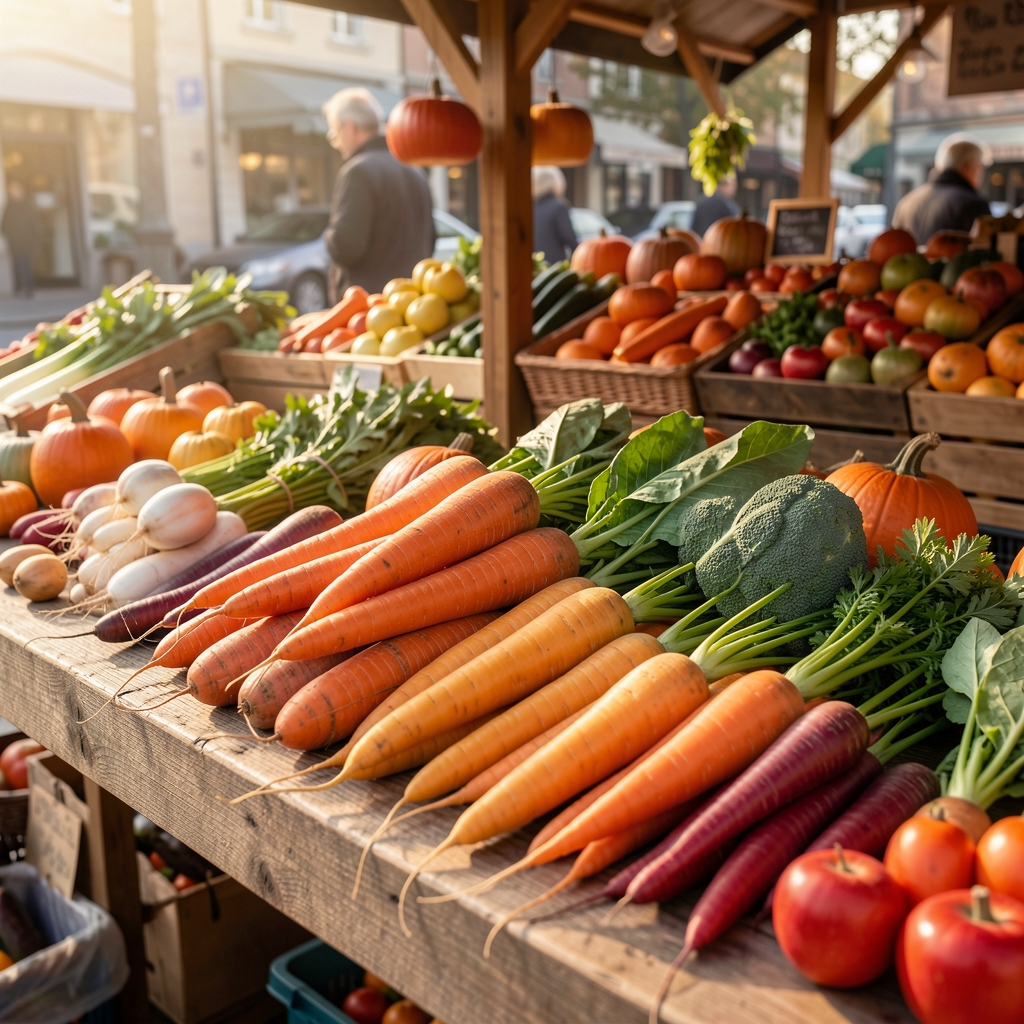
When the seasons shift, so does what is available at the market. The question worth examining is whether the body's weekly rhythm changes alongside the produce on offer — and what that correspondence, if any, might reveal about weight and nutritional balance over the course of a year.
The Rhythm of What Grows When
England's growing calendar is not dramatic by the standards of more continental climates, but it is distinct. January brings root vegetables and stored brassicas. April opens the season for the first tender greens. By August the markets overflow with courgettes, tomatoes, and stone fruit. November closes with squash and celeriac standing in long rows.
For anyone keeping a food journal across twelve months, a pattern becomes visible: the variety of plant foods on the weekly plate rises and falls with the season. This is not merely an aesthetic observation. The nutritional composition of what is available shifts meaningfully across the year. Spring leaves and early herbs carry a different profile of micronutrients than the dense starchy roots of autumn.
Whether a person actively seeks seasonal produce or simply responds to what is most prominently stocked or most affordably priced, their plate often reflects the calendar in ways they may not have noticed before recording it.
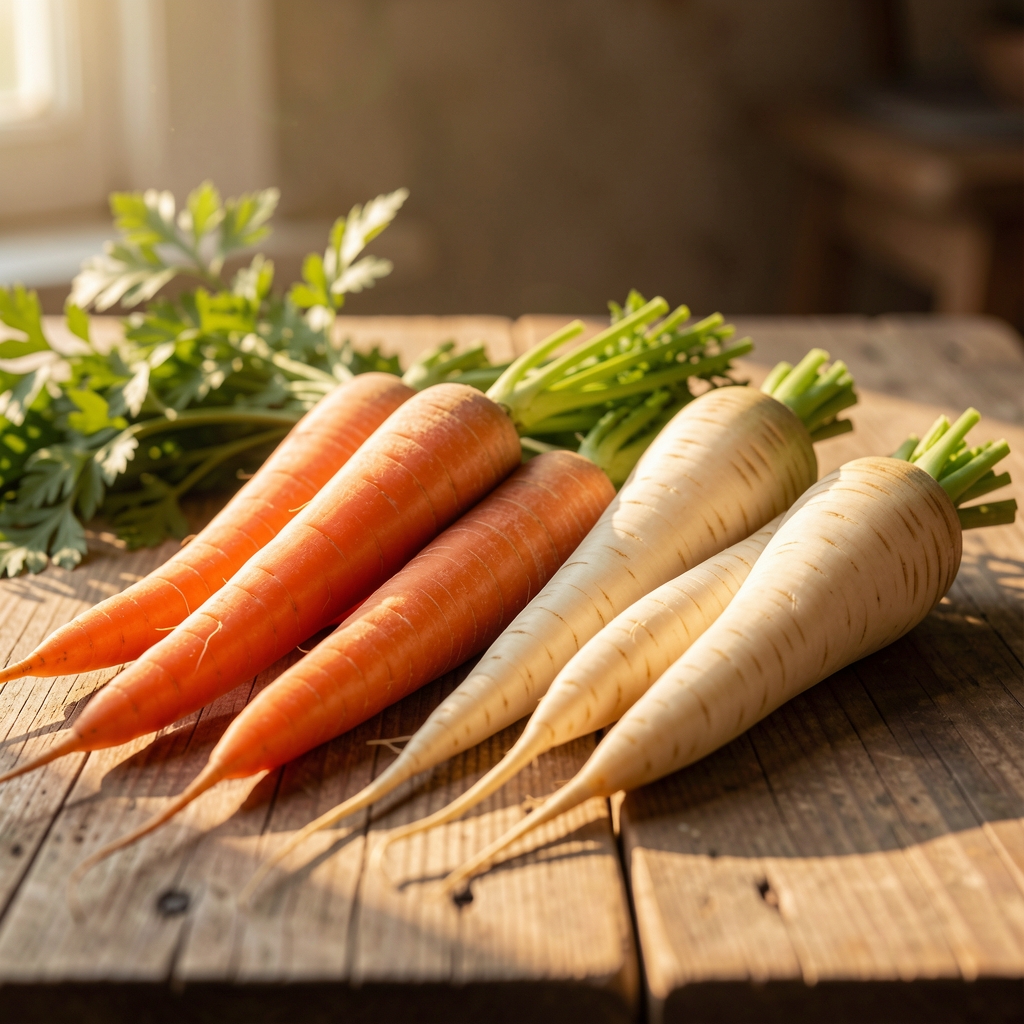
AUTUMN ROOT HARVEST — ROOT VEGETABLES OFFER SUSTAINED ENERGY THROUGH COOLER MONTHS
Portion Awareness and the Density of Winter Produce
One consistent observation across food diaries kept through the winter months is that portions of starchy vegetables — potatoes, parsnips, swede, butternut squash — tend to be larger than equivalent portions of summer produce. This is partly preparation-driven: roasting a root vegetable produces a denser, heavier plate than assembling a salad of summer leaves and cucumber.
Portion awareness in winter requires a different calibration than in summer. A bowl of roasted root vegetables carries substantially more energy than the same-sized bowl of dressed salad leaves. Neither is the wrong choice, but recognising the difference in what the body receives is a foundation of informed eating.
The nutritionist's note here is practical: weighing or measuring winter portions occasionally — not obsessively, but as an orientation exercise — gives a person a clearer sense of what they are consuming across the season. Those who report doing this even intermittently describe a recalibration of their intuitive portion judgement that carries through even on days when they are not actively measuring.
This is not about restriction. It is about building an accurate internal map of what a reasonable serving looks like across the different textures, densities, and cooking methods that winter produce demands.
"The plate in February is not the plate in July. Recognising that difference is the beginning of a genuinely seasonal approach to eating."
— HARRIET ASHCROFT, DREVANI JOURNAL
Summer Abundance and the Body's Response
The months from June through September present a different nutritional landscape. Courgettes, peppers, tomatoes, cucumbers, green beans, fresh peas, and a range of stone fruits are available with a variety and freshness that the winter months cannot match. Water content is high. Energy density, generally, is lower. The experience of eating seasonally in summer is one of abundance without heaviness.
Food diaries from summer months consistently show a different rhythm: lighter meals, longer gaps between eating, a greater proportion of raw and lightly prepared foods. Some contributors to the journal describe this shift as natural and unconscious — they simply find themselves less drawn to heavy cooked dishes when the weather is warm and the market stalls are bright with colour.
Weight balance across the summer months, for those who eat broadly seasonally, tends to find a natural equilibrium — not through active effort but through the changed character of what is available. This is one of the arguments for making seasonal produce a structural part of the weekly food rhythm rather than an occasional gesture.
Building a Weekly Rhythm Around the Season
Establishing a seasonal weekly rhythm does not require access to a farmers' market or a kitchen garden, though both help. It requires a modest shift in how the weekly shop is approached: instead of assembling a fixed list of the same items every week, the practice begins by asking what is currently in season locally.
A straightforward method observed in the food diaries reviewed at this journal: one or two seasonal items form the anchor of the week's cooking. These anchor ingredients then determine what else is bought to complement them. In January, that anchor might be a Savoy cabbage and a bunch of kale. In April, it might be a bag of Jersey Royals and some purple sprouting broccoli. The rest of the shop adjusts around those anchors.
This anchor approach accomplishes several things simultaneously: it ensures the diet contains genuinely seasonal produce, it reduces food waste because the purchases are anchored to a planned use, and it encourages variety across the year as the anchors rotate with the seasons.
Food journalling is particularly useful when adopted alongside the anchor method. Seeing the weekly record accumulate across months makes the seasonal rhythm visible in a way that memory alone cannot sustain. Several contributors report that reviewing three months of journals was the first time they understood their own seasonal eating pattern.
- Winter root vegetables are more energy-dense than summer produce of the same volume — portion awareness adjusts accordingly.
- The anchor-ingredient method builds a seasonal rhythm without requiring fixed weekly meal plans.
- Food journalling across multiple months reveals seasonal patterns that single-week records cannot show.
- Weight balance in summer often follows naturally from the lower energy density of seasonal summer produce.
The Record of Seasonal Eating Over a Year
Those who commit to a year of food journalling with attention to seasonal variation describe a notable shift in how they relate to the weight fluctuations that are normal across the year. Rather than interpreting the slightly heavier feeling of November as a failure, they begin to understand it as a natural consequence of the season's produce and the body's adjusted rhythm.
This reframing has a practical value. It moves the conversation away from short-term weight reactions — the Monday after a holiday weekend, the weigh-in after a festive month — and toward a longer view in which weight is understood as part of a seasonal cycle. Not every moment of the year will look identical on the scale. The question is whether the annual arc is moving in a broadly positive direction.
For this journal, a year of seasonal food records is one of the most instructive documents a person can keep. It is not a weight-loss programme. It is a nutritional autobiography — a record of what was eaten, when, and from where, that accumulates into a readable account of how food and body relate across the full rotation of the calendar.

Harriet Ashcroft writes on seasonal food patterns and the intersection of cooking practice with weight awareness. Her work draws on food journal archives contributed by readers across England.
More from this author →